Form 1095-CTax year 2025Free reference

Lines 14, 15 and 16, one month at a time.

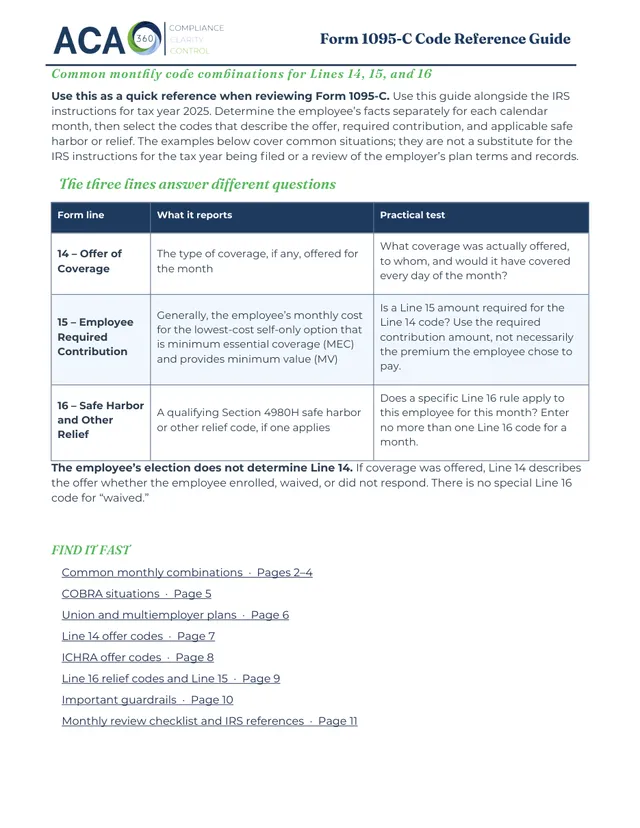
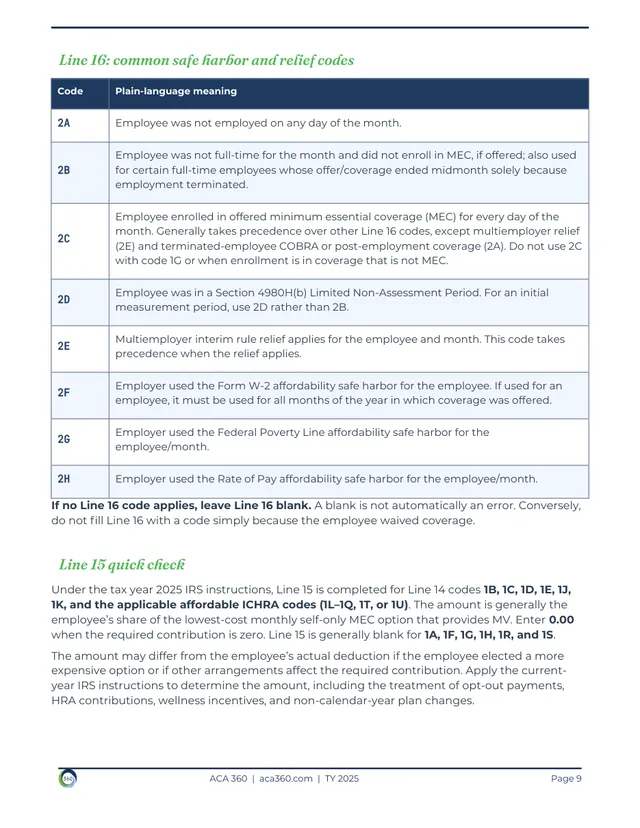
Each month of Part II answers three questions: what was offered, what the employee had to pay, and whether a safe harbor or relief applies. Work through a month below and watch the codes land on the form, or take the 11-page guide with you.

First page of the Form 1095-C Code Reference Guide
  1. 14Offer of Coverage

    What coverage was actually offered, to whom, and would it have covered every day of the month?

    The type of coverage, if any, offered for the month.

  2. 15Employee Required Contribution

    Is a Line 15 amount required for the Line 14 code?

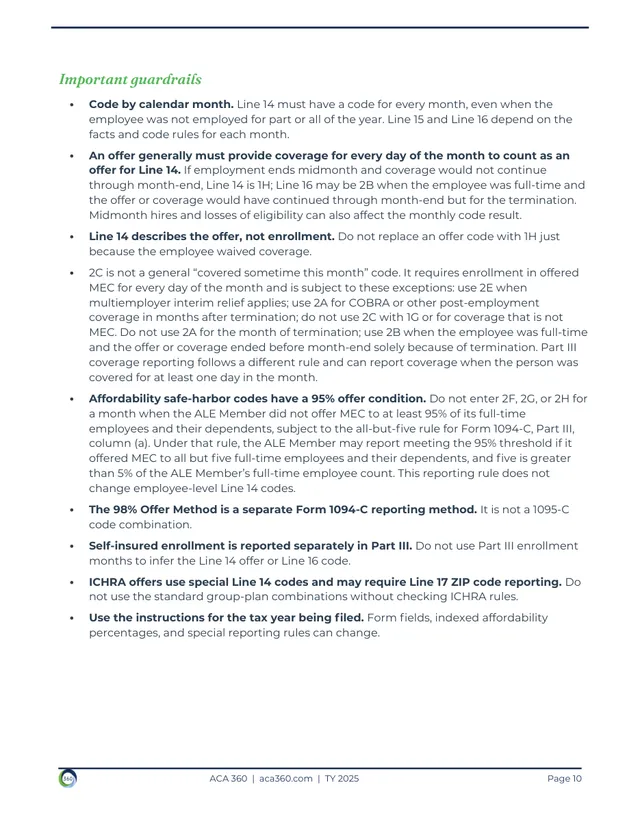
    Generally, the employee’s monthly cost for the lowest-cost self-only option that is minimum essential coverage (MEC) and provides minimum value (MV). Use the required contribution amount, not necessarily the premium the employee chose to pay.

  3. 16Safe Harbor and Other Relief

    Does a specific Line 16 rule apply to this employee for this month?

    A qualifying Section 4980H safe harbor or other relief code, if one applies. Enter no more than one Line 16 code for a month.

The employee’s election does not determine Line 14. If coverage was offered, Line 14 describes the offer whether the employee enrolled, waived, or did not respond. There is no special Line 16 code for “waived.”

Code a month on the form

Pick a month and answer the questions. Each answer settles a line, in the order the guide applies them, and the code is written into Part II as soon as it’s known. Load an example to see a whole year. The questions follow the guide’s tables; they don’t replace a review of the plan terms and records.

Example years

Part IIEmployee Offer of CoverageForm 1095-C (2025)
14Offer of Coverage (enter required code)
15Employee Required Contribution (see instructions)
16Section 4980H Safe Harbor and Other Relief (enter code, if applicable)
17ZIP Code (enter code, if applicable)
1H
1H
1H
1E
1E
1E
1E
1E
1E
1E
1H
1H
95.00
95.00
95.00
95.00
95.00
95.00
95.00
2D
2D
2D
2C
2C
2C
2C
2C
2C
2C
2B
2A

A teaching copy of Part II, filled in from the reference guide. Dollar amounts and ZIP codes in the examples are made up.

Coding January

    All 28 codes

    Line 14 has 20 offer codes, ten of them for ICHRAs. Line 16 has eight. Pick a key, or search for a word like “terminated” or “W-2”.

    Line 14 Offer of coverage

    Line 14 ICHRA offers

    Line 16 Safe harbor and relief

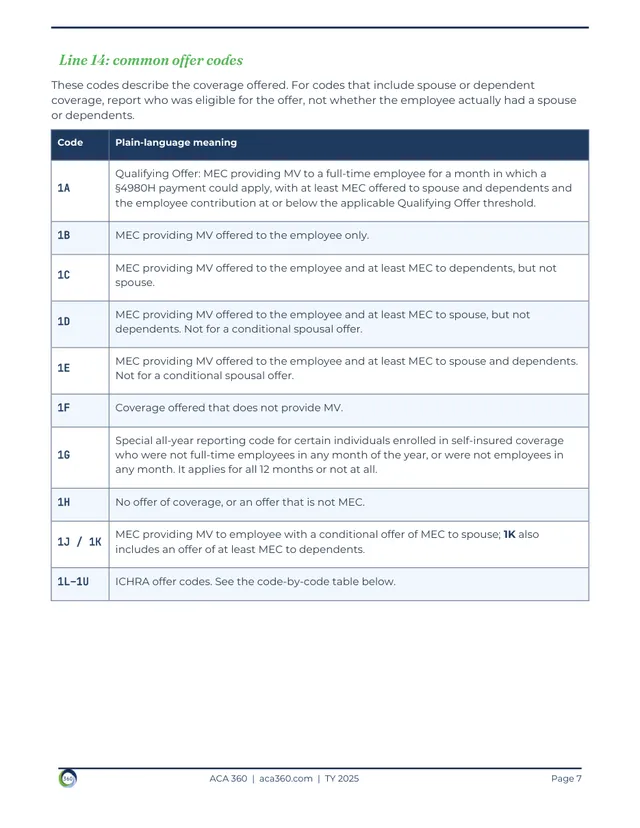
    These codes describe the coverage offered. For codes that include spouse or dependent coverage, report who was eligible for the offer, not whether the employee actually had a spouse or dependents.

    Line 14 · Offer of coverage

    1A

    Qualifying Offer: MEC providing MV to a full-time employee for a month in which a §4980H payment could apply, with at least MEC offered to spouse and dependents and the employee contribution at or below the applicable Qualifying Offer threshold.

    Line 15Generally blank with this code.

    In the guide’s combinations
    Line 14 · Offer of coverage

    1C

    MEC providing MV offered to the employee and at least MEC to dependents, but not spouse.

    Line 15Enter the employee required contribution.

    In the guide’s combinations

    Line 14 · Offer of coverage

    1D

    MEC providing MV offered to the employee and at least MEC to spouse, but not dependents. Not for a conditional spousal offer.

    Line 15Enter the employee required contribution.

    In the guide’s combinations

    Line 14 · Offer of coverage

    1F

    Coverage offered that does not provide MV.

    Line 15Generally blank with this code.

    In the guide’s combinations

    Line 14 · Offer of coverage

    1G

    Special all-year reporting code for certain individuals enrolled in self-insured coverage who were not full-time employees in any month of the year, or were not employees in any month. It applies for all 12 months or not at all.

    Line 15Generally blank with this code.

    In the guide’s combinations

    Line 14 · Offer of coverage

    1H

    No offer of coverage, or an offer that is not MEC.

    Line 15Generally blank with this code.

    Line 14 · Offer of coverage

    1J

    MEC providing MV to employee with a conditional offer of MEC to spouse.

    Line 15Enter the employee required contribution.

    In the guide’s combinations

    Line 14 · Offer of coverage

    1K

    MEC providing MV to employee with a conditional offer of MEC to spouse, and an offer of at least MEC to dependents.

    Line 15Enter the employee required contribution.

    In the guide’s combinations

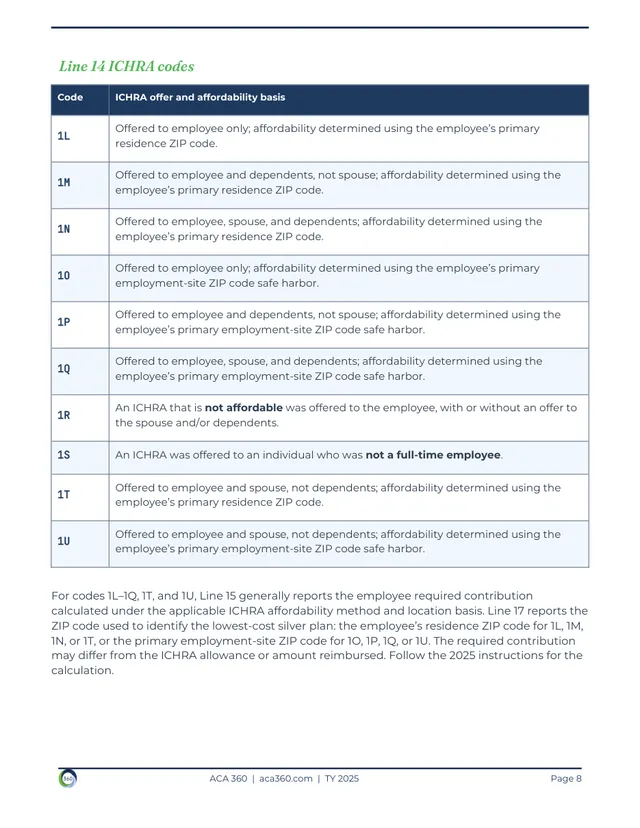
    Line 14 · ICHRA offer

    1L

    ICHRA offered to employee only; affordability determined using the employee’s primary residence ZIP code.

    Line 15Enter the employee required contribution.

    Line 17The employee’s residence ZIP code.

    In the guide’s combinations

    Line 14 · ICHRA offer

    1M

    ICHRA offered to employee and dependents, not spouse; affordability determined using the employee’s primary residence ZIP code.

    Line 15Enter the employee required contribution.

    Line 17The employee’s residence ZIP code.

    In the guide’s combinations

    Line 14 · ICHRA offer

    1N

    ICHRA offered to employee, spouse, and dependents; affordability determined using the employee’s primary residence ZIP code.

    Line 15Enter the employee required contribution.

    Line 17The employee’s residence ZIP code.

    In the guide’s combinations

    Line 14 · ICHRA offer

    1O

    ICHRA offered to employee only; affordability determined using the employee’s primary employment-site ZIP code safe harbor.

    Line 15Enter the employee required contribution.

    Line 17The primary employment-site ZIP code.

    In the guide’s combinations

    Line 14 · ICHRA offer

    1P

    ICHRA offered to employee and dependents, not spouse; affordability determined using the employee’s primary employment-site ZIP code safe harbor.

    Line 15Enter the employee required contribution.

    Line 17The primary employment-site ZIP code.

    In the guide’s combinations

    Line 14 · ICHRA offer

    1Q

    ICHRA offered to employee, spouse, and dependents; affordability determined using the employee’s primary employment-site ZIP code safe harbor.

    Line 15Enter the employee required contribution.

    Line 17The primary employment-site ZIP code.

    In the guide’s combinations

    Line 14 · ICHRA offer

    1R

    An ICHRA that is not affordable was offered to the employee, with or without an offer to the spouse and/or dependents.

    Line 15Generally blank with this code.

    In the guide’s combinations

    Line 14 · ICHRA offer

    1S

    An ICHRA was offered to an individual who was not a full-time employee.

    Line 15Generally blank with this code.

    In the guide’s combinations

    Line 14 · ICHRA offer

    1T

    ICHRA offered to employee and spouse, not dependents; affordability determined using the employee’s primary residence ZIP code.

    Line 15Enter the employee required contribution.

    Line 17The employee’s residence ZIP code.

    In the guide’s combinations

    Line 14 · ICHRA offer

    1U

    ICHRA offered to employee and spouse, not dependents; affordability determined using the employee’s primary employment-site ZIP code safe harbor.

    Line 15Enter the employee required contribution.

    Line 17The primary employment-site ZIP code.

    In the guide’s combinations

    Line 16 · Safe harbor or relief

    2C

    Employee enrolled in offered minimum essential coverage (MEC) for every day of the month. Generally takes precedence over other Line 16 codes, except multiemployer relief (2E) and terminated-employee COBRA or post-employment coverage (2A). Do not use 2C with code 1G or when enrollment is in coverage that is not MEC.

    In the guide’s combinations

    Line 16 · Safe harbor or relief

    2F

    Employer used the Form W-2 affordability safe harbor for the employee. If used for an employee, it must be used for all months of the year in which coverage was offered.

    In the guide’s combinations

    Common combinations

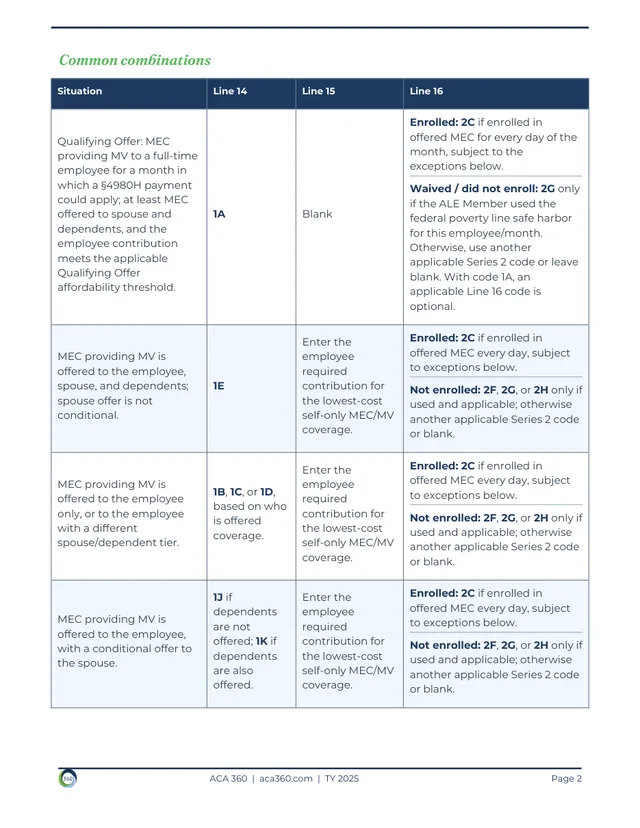
    The guide’s tables, row by row. Check each calendar month on its own: the offer code and Line 15 depend on the plan design and eligibility tier, and Line 16 depends on enrollment, employment and full-time status, any LNAP or other relief, and the affordability method actually used.

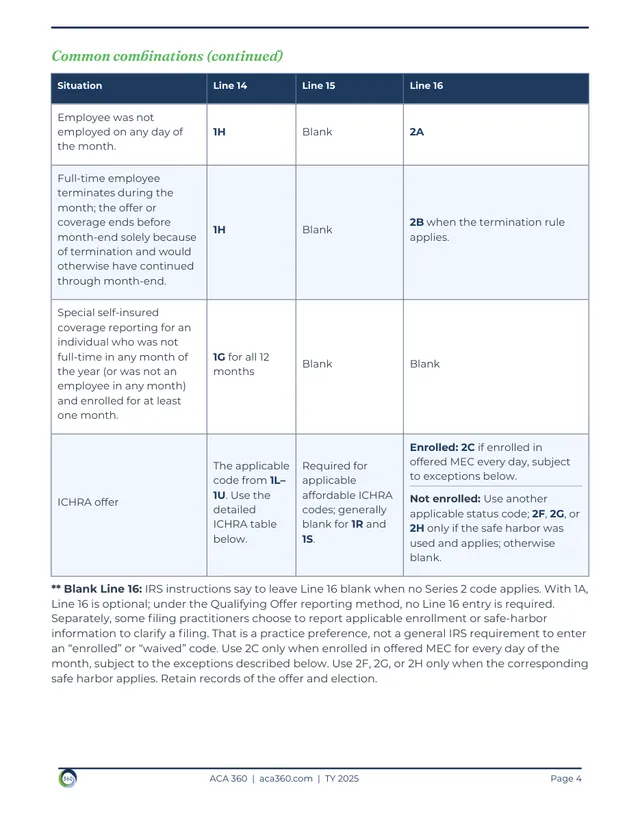
    Common combinations

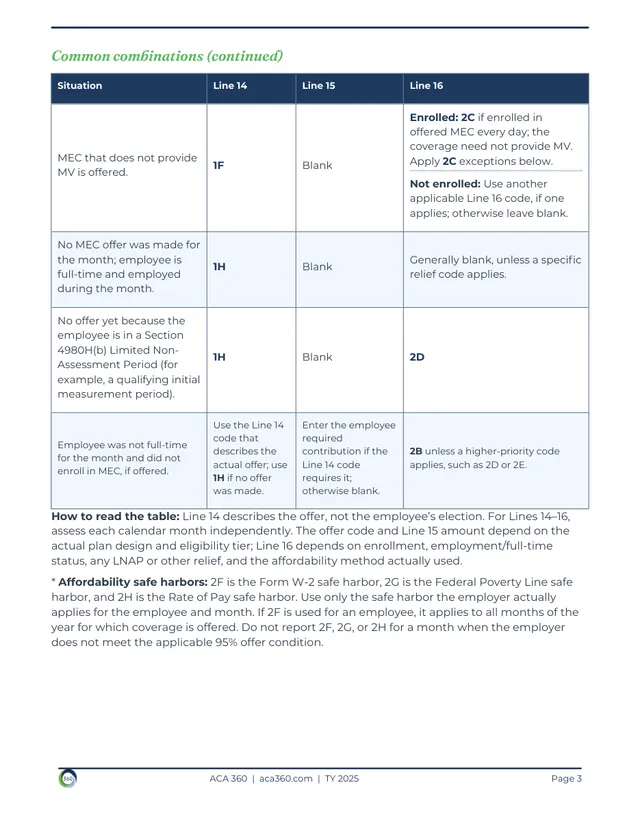
    Line 14 describes the offer, not the employee’s election. For Lines 14–16, assess each calendar month independently. The offer code and Line 15 amount depend on the actual plan design and eligibility tier; Line 16 depends on enrollment, employment/full-time status, any LNAP or other relief, and the affordability method actually used.

    Situation14 Offer15 Contribution16 Safe harbor / relief
    01
    Qualifying Offer

    Qualifying Offer: MEC providing MV to a full-time employee for a month in which a §4980H payment could apply; at least MEC offered to spouse and dependents, and the employee contribution meets the applicable Qualifying Offer affordability threshold.

    1A
    Blank

    Enrolled 2C if enrolled in offered MEC for every day of the month, subject to the exceptions below.

    Waived / did not enroll 2G only if the ALE Member used the federal poverty line safe harbor for this employee/month. Otherwise, use another applicable Series 2 code or leave blank. With code 1A, an applicable Line 16 code is optional.

    02
    Employee, spouse, and dependents offered

    MEC providing MV is offered to the employee, spouse, and dependents; spouse offer is not conditional.

    1E
    Enter the employee required contribution for the lowest-cost self-only MEC/MV coverage.

    Enrolled 2C if enrolled in offered MEC every day, subject to exceptions below.

    Not enrolled 2F, 2G, or 2H only if used and applicable; otherwise another applicable Series 2 code or blank.

    03
    Employee only, or a different tier

    MEC providing MV is offered to the employee only, or to the employee with a different spouse/dependent tier.

    1B, 1C, or 1D, based on who is offered coverage.
    Enter the employee required contribution for the lowest-cost self-only MEC/MV coverage.

    Enrolled 2C if enrolled in offered MEC every day, subject to exceptions below.

    Not enrolled 2F, 2G, or 2H only if used and applicable; otherwise another applicable Series 2 code or blank.

    04
    Conditional spousal offer

    MEC providing MV is offered to the employee, with a conditional offer to the spouse.

    1J if dependents are not offered; 1K if dependents are also offered.
    Enter the employee required contribution for the lowest-cost self-only MEC/MV coverage.

    Enrolled 2C if enrolled in offered MEC every day, subject to exceptions below.

    Not enrolled 2F, 2G, or 2H only if used and applicable; otherwise another applicable Series 2 code or blank.

    05
    MEC without minimum value

    MEC that does not provide MV is offered.

    1F
    Blank

    Enrolled 2C if enrolled in offered MEC every day; the coverage need not provide MV. Apply 2C exceptions below.

    Not enrolled Use another applicable Line 16 code, if one applies; otherwise leave blank.

    06
    No offer to a full-time employee

    No MEC offer was made for the month; employee is full-time and employed during the month.

    1H
    Blank

    Generally blank, unless a specific relief code applies.

    07
    Limited Non-Assessment Period

    No offer yet because the employee is in a Section 4980H(b) Limited Non-Assessment Period (for example, a qualifying initial measurement period).

    1H
    Blank

    2D

    08
    Not full-time and not enrolled

    Employee was not full-time for the month and did not enroll in MEC, if offered.

    Use the Line 14 code that describes the actual offer; use 1H if no offer was made.
    Enter the employee required contribution if the Line 14 code requires it; otherwise blank.

    2B unless a higher-priority code applies, such as 2D or 2E.

    09
    Not employed during the month

    Employee was not employed on any day of the month.

    1H
    Blank

    2A

    10
    Full-time employee terminates midmonth

    Full-time employee terminates during the month; the offer or coverage ends before month-end solely because of termination and would otherwise have continued through month-end.

    1H
    Blank

    2B when the termination rule applies.

    11
    Self-insured, never full-time

    Special self-insured coverage reporting for an individual who was not full-time in any month of the year (or was not an employee in any month) and enrolled for at least one month.

    1G for all 12 months
    Blank

    Blank

    12
    ICHRA offer

    ICHRA offer

    The applicable code from 1L–1U. Use the detailed ICHRA codes in the code finder.
    Required for applicable affordable ICHRA codes; generally blank for 1R and 1S.

    Enrolled 2C if enrolled in offered MEC every day, subject to exceptions below.

    Not enrolled Use another applicable status code; 2F, 2G, or 2H only if the safe harbor was used and applies; otherwise blank.

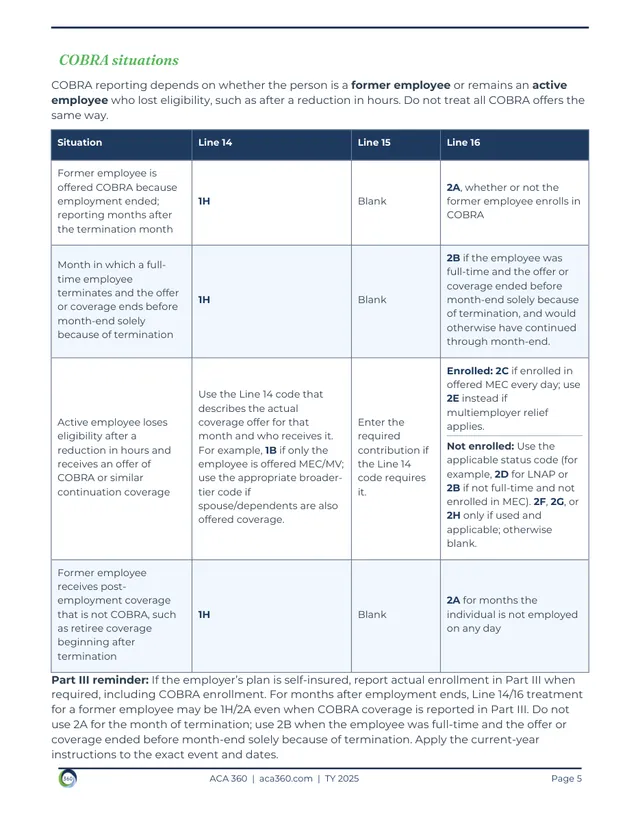
    COBRA

    COBRA reporting depends on whether the person is a former employee or remains an active employee who lost eligibility, such as after a reduction in hours. Do not treat all COBRA offers the same way.

    Situation14 Offer15 Contribution16 Safe harbor / relief
    01
    Former employee offered COBRA

    Former employee is offered COBRA because employment ended; reporting months after the termination month

    1H
    Blank

    2A, whether or not the former employee enrolls in COBRA

    02
    The month a full-time employee terminates

    Month in which a full-time employee terminates and the offer or coverage ends before month-end solely because of termination

    1H
    Blank

    2B if the employee was full-time and the offer or coverage ended before month-end solely because of termination, and would otherwise have continued through month-end.

    03
    Active employee loses eligibility

    Active employee loses eligibility after a reduction in hours and receives an offer of COBRA or similar continuation coverage

    Use the Line 14 code that describes the actual coverage offer for that month and who receives it. For example, 1B if only the employee is offered MEC/MV; use the appropriate broader-tier code if spouse/dependents are also offered coverage.
    Enter the required contribution if the Line 14 code requires it.

    Enrolled 2C if enrolled in offered MEC every day; use 2E instead if multiemployer relief applies.

    Not enrolled Use the applicable status code (for example, 2D for LNAP or 2B if not full-time and not enrolled in MEC). 2F, 2G, or 2H only if used and applicable; otherwise blank.

    04
    Post-employment coverage that is not COBRA

    Former employee receives post-employment coverage that is not COBRA, such as retiree coverage beginning after termination

    1H
    Blank

    2A for months the individual is not employed on any day

    Part III reminder: If the employer’s plan is self-insured, report actual enrollment in Part III when required, including COBRA enrollment. For months after employment ends, Line 14/16 treatment for a former employee may be 1H/2A even when COBRA coverage is reported in Part III. Do not use 2A for the month of termination; use 2B when the employee was full-time and the offer or coverage ended before month-end solely because of termination. Apply the current-year instructions to the exact event and dates.

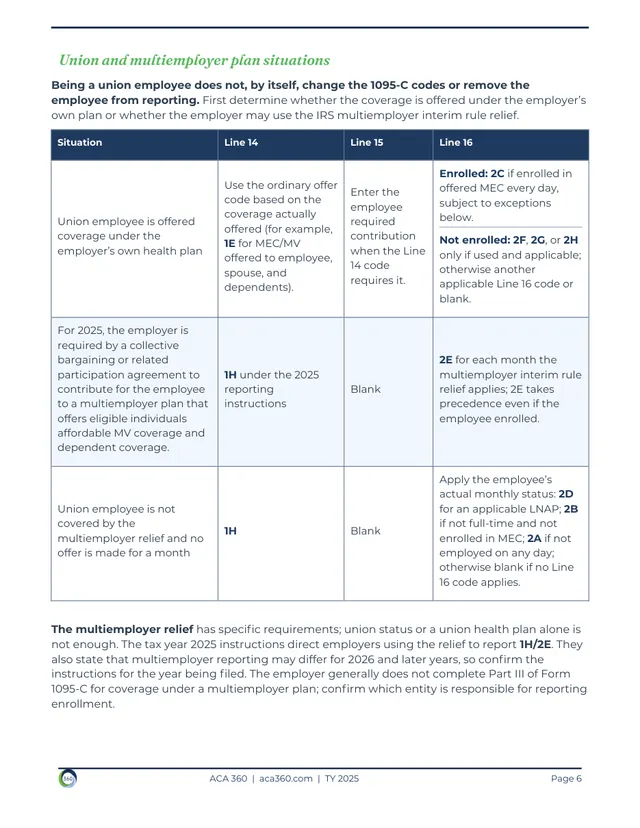
    Union and multiemployer

    Being a union employee does not, by itself, change the 1095-C codes or remove the employee from reporting. First determine whether the coverage is offered under the employer’s own plan or whether the employer may use the IRS multiemployer interim rule relief.

    Situation14 Offer15 Contribution16 Safe harbor / relief
    01
    Offered the employer’s own plan

    Union employee is offered coverage under the employer’s own health plan

    Use the ordinary offer code based on the coverage actually offered (for example, 1E for MEC/MV offered to employee, spouse, and dependents).
    Enter the employee required contribution when the Line 14 code requires it.

    Enrolled 2C if enrolled in offered MEC every day, subject to exceptions below.

    Not enrolled 2F, 2G, or 2H only if used and applicable; otherwise another applicable Line 16 code or blank.

    02
    Multiemployer interim rule relief

    For 2025, the employer is required by a collective bargaining or related participation agreement to contribute for the employee to a multiemployer plan that offers eligible individuals affordable MV coverage and dependent coverage.

    1H under the 2025 reporting instructions
    Blank

    2E for each month the multiemployer interim rule relief applies; 2E takes precedence even if the employee enrolled.

    03
    No relief and no offer

    Union employee is not covered by the multiemployer relief and no offer is made for a month

    1H
    Blank

    Apply the employee’s actual monthly status: 2D for an applicable LNAP; 2B if not full-time and not enrolled in MEC; 2A if not employed on any day; otherwise blank if no Line 16 code applies.

    The multiemployer relief has specific requirements; union status or a union health plan alone is not enough. The tax year 2025 instructions direct employers using the relief to report 1H/2E. They also state that multiemployer reporting may differ for 2026 and later years, so confirm the instructions for the year being filed. The employer generally does not complete Part III of Form 1095-C for coverage under a multiemployer plan; confirm which entity is responsible for reporting enrollment.

    Affordability safe harbors. 2F is the Form W-2 safe harbor, 2G is the Federal Poverty Line safe harbor, and 2H is the Rate of Pay safe harbor. Use only the safe harbor the employer actually applies for the employee and month. If 2F is used for an employee, it applies to all months of the year for which coverage is offered. Do not report 2F, 2G, or 2H for a month when the employer does not meet the applicable 95% offer condition.

    Blank Line 16. IRS instructions say to leave Line 16 blank when no Series 2 code applies. With 1A, Line 16 is optional; under the Qualifying Offer reporting method, no Line 16 entry is required. Separately, some filing practitioners choose to report applicable enrollment or safe-harbor information to clarify a filing. That is a practice preference, not a general IRS requirement to enter an “enrolled” or “waived” code. Use 2C only when enrolled in offered MEC for every day of the month, subject to the exceptions described below. Use 2F, 2G, or 2H only when the corresponding safe harbor applies. Retain records of the offer and election.

    Guardrails

    Nine rules from the guide that hold whichever combination applies.

    1. 01

      Code by calendar month

      Line 14 must have a code for every month, even when the employee was not employed for part or all of the year. Line 15 and Line 16 depend on the facts and code rules for each month.

    2. 02

      An offer has to cover every day of the month

      An offer generally must provide coverage for every day of the month to count as an offer for Line 14. If employment ends midmonth and coverage would not continue through month-end, Line 14 is 1H; Line 16 may be 2B when the employee was full-time and the offer or coverage would have continued through month-end but for the termination. Midmonth hires and losses of eligibility can also affect the monthly code result.

    3. 03

      Line 14 describes the offer, not enrollment

      Do not replace an offer code with 1H just because the employee waived coverage.

    4. 04

      2C is not “covered sometime this month”

      It requires enrollment in offered MEC for every day of the month and is subject to these exceptions: use 2E when multiemployer interim relief applies; use 2A for COBRA or other post-employment coverage in months after termination; do not use 2C with 1G or for coverage that is not MEC. Do not use 2A for the month of termination; use 2B when the employee was full-time and the offer or coverage ended before month-end solely because of termination. Part III coverage reporting follows a different rule and can report coverage when the person was covered for at least one day in the month.

    5. 05

      Safe-harbor codes have a 95% offer condition

      Do not enter 2F, 2G, or 2H for a month when the ALE Member did not offer MEC to at least 95% of its full-time employees and their dependents, subject to the all-but-five rule for Form 1094-C, Part III, column (a). Under that rule, the ALE Member may report meeting the 95% threshold if it offered MEC to all but five full-time employees and their dependents, and five is greater than 5% of the ALE Member’s full-time employee count. This reporting rule does not change employee-level Line 14 codes.

    6. 06

      The 98% Offer Method is not a 1095-C code

      The 98% Offer Method is a separate Form 1094-C reporting method. It is not a 1095-C code combination.

    7. 07

      Part III is reported separately

      Self-insured enrollment is reported separately in Part III. Do not use Part III enrollment months to infer the Line 14 offer or Line 16 code.

    8. 08

      ICHRA offers have their own codes

      ICHRA offers use special Line 14 codes and may require Line 17 ZIP code reporting. Do not use the standard group-plan combinations without checking ICHRA rules.

    9. 09

      Use the instructions for the year being filed

      Form fields, indexed affordability percentages, and special reporting rules can change.

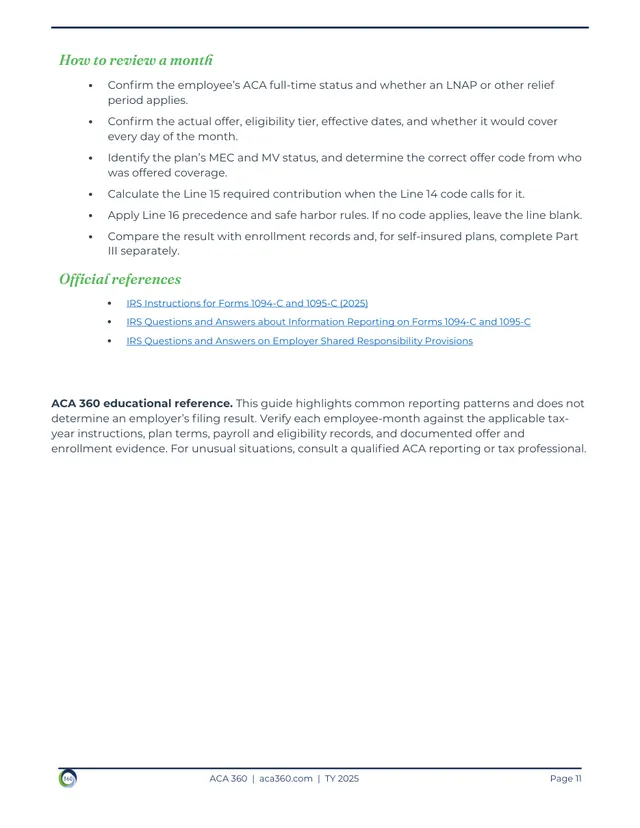
    Reviewing a month, in order

    1. 1Confirm the employee’s ACA full-time status and whether an LNAP or other relief period applies.
    2. 2Confirm the actual offer, eligibility tier, effective dates, and whether it would cover every day of the month.
    3. 3Identify the plan’s MEC and MV status, and determine the correct offer code from who was offered coverage.
    4. 4Calculate the Line 15 required contribution when the Line 14 code calls for it.
    5. 5Apply Line 16 precedence and safe harbor rules. If no code applies, leave the line blank.
    6. 6Compare the result with enrollment records and, for self-insured plans, complete Part III separately.

    Take the guide into filing season

    The PDF has every table on this page, laid out for print. Send it to whoever reviews your 1095-Cs, attach it to your filing checklist, or link to it from your own benefits resources. The link stays the same.

    aca360.com/downloads/aca360-form-1095-c-code-reference-guide.pdf

    Official references

    ACA 360 educational reference. This guide highlights common reporting patterns and does not determine an employer’s filing result. Verify each employee-month against the applicable tax-year instructions, plan terms, payroll and eligibility records, and documented offer and enrollment evidence. For unusual situations, consult a qualified ACA reporting or tax professional.

    Want someone to check the codes before the forms go out?

    ACA 360 reviews offer, contribution, and safe harbor codes against payroll and enrollment records every month, so filing season is a final check instead of a scramble.